
We stand on the water’s edge.
From the ocean before us, there’s a subdued hush. It’s little more than a hoarse sigh, a spurt of salty laughter. The sand is sucked from beneath the soles of our bare feet – having reached the limits of terra firma, we’ve also run out of any reliable surface on which to stand. There’s a prickling numbness as the cold suds wash over our toes.
Our eyes stretch over a horizontal curtain, behind which we are not permitted to snoop – not without the right preparation or equipment. Peer though we might, we can’t see beyond the crinkled sheet that separates us from that vast abyss.
There’s some hesitation about descending into this inscrutable part of our planet. After all, it’s an environment that’s hostile to us. It’s dark, cold and bewildering down there, stranger than outer space.
Somewhere in our memory bank is the advice that deep-ocean pressure can cause the human body to catastrophically implode. Our ears will pop; our eyes may begin to bulge.
We’ll plunge in nevertheless.
*
Our guide for this descent will be Aldous Kelly. He’s not exactly a divemaster; not an oceanographer nor a marine biologist. Yet he may be the best sort of companion for a trip into this surreal, subaqueous realm, for Aldous is an artist. His imagination is finely tuned to that which is strange, unexpected or confounding.
You may have seen his work. His drawings often focus on humble weirdos who appear to have nowhere better to be. Aldous also created award-winning artwork for Ten Days on the Island 2025, which infused the Festival with bioluminous marsupials and the technicolour effects of the aurora australis.
Invited to create another world for the 2027 Festival – based, this time, on the secrets of the deep – Aldous decided to meet with scientists in search of a starting point for his work. It seemed a wise course of action. After all, Tasmania is an international hub of ocean research. There’s a lot to learn, and there’s no need to wade through the weeds alone.
It’s not that Aldous knew nothing about marine environments, having once worked as a fisherman in New Zealand, where he grew up. Aldous’s fishing stories have an even more supernatural bent than most. For a young fella with an artistic temperament, his encounters with the denizens of the deep might have made a lasting impression.
The list of species that have been discovered in the ocean’s depths is a rogues’ gallery of strange beasts and behemoths. Subject to intimidating forces, they have evolved in mystifying ways. They glow in the dark or emit searchlights; some have transparent skin or have gelatinous bodies to withstand the pressure.
Among their kind are brutal hunters (such as the so-called goblin shark, which slingshots elastic jaws at prey), while others scavenge the organic debris that drifts down the water column. Certain organisms even survive through chemosynthesis, converting inorganic materials into food – that is, they eat hydrogen sulphide for lunch.
*
Aldous describes a squid that lives in the twilight zone, some hundreds of metres beneath the surface of the ocean. It’s known as the strawberry squid, so-called because of its rosy body, which is dotted with light-emitting organs that resemble seeds – though you’d have to be a bit daft to confuse it with fruit.
It’s also known less flatteringly as the cock-eyed squid. Travelling through diffuse light, this squid has evolved two entirely different eyes. One is large, yellow-pigmented and oriented so that it can see upwards; the other is small, blue, more central and has evolved to view bioluminescence.
I can see why such a creature might have caught the attention of Aldous Kelly.
*
A different kind of inspiration came from chatting with scientists. Aldous realised that even for those who have spent a lifetime studying the subject, the ocean’s depths are full of unknowns. “We know more about space than we do about the deep sea,” Aldous reflects. “Every time they go down there, they find a new organism. It’s kind of reassuring that there is a place on Earth that our insatiable quest for knowledge and domination is yet to conquer.”
This fact wasn’t a deterrent – far from it, in fact, because it freed Aldous to invent what could be down there. No-one can in all honesty say that what he’s drawing doesn’t exist. The next submarine mission might turn up one of the freaky figures in the Festival brochure.
*
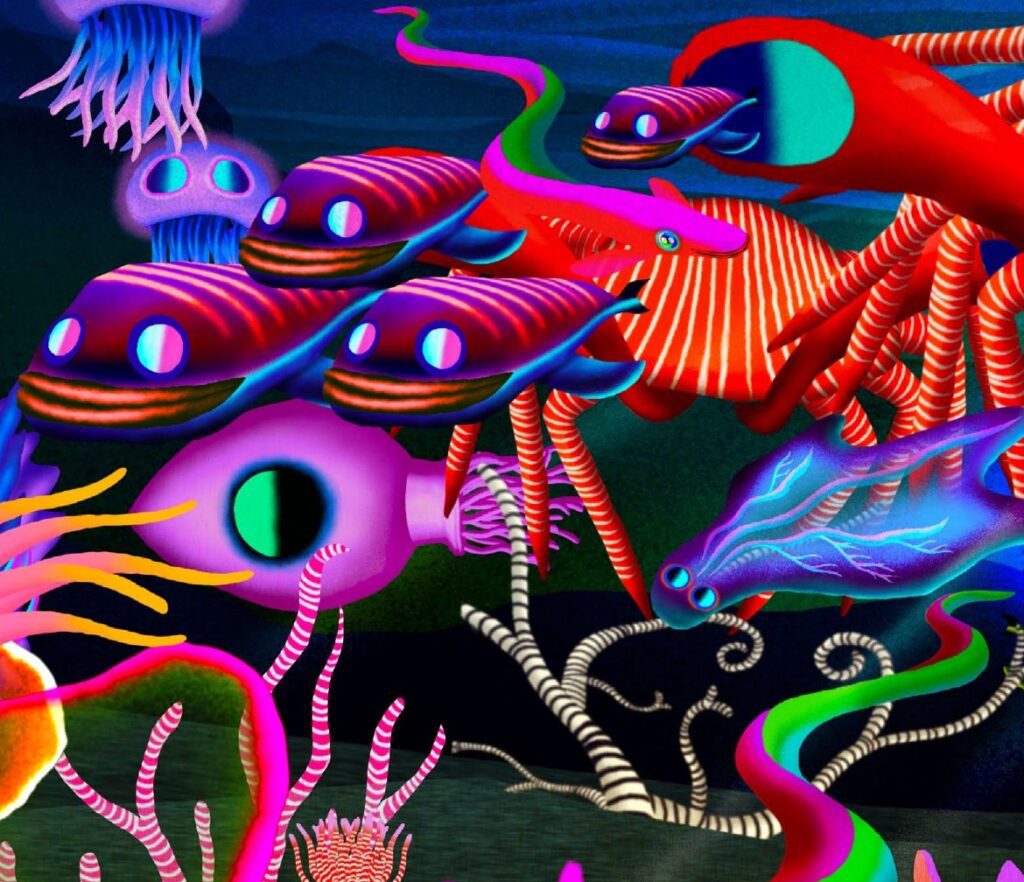
What will we find on our deep dive into Aldous’s imagination? Iridescent squid shimmer and dance. Fluffy crustaceans float about; eels with emerald or fuchsia skin slide through seaweeds. There’s a handfish that looks like it’s about to do a cartwheel.
We notice a creature that may be a cousin of the gelatinous deep-sea depressive known as the blobfish. But Aldous’s version sports mirrored sunglasses, looking as happy as Larry a kilometre beneath the surface of the ocean.
Aldous’s ghostly, ghoulish, garish critters throng in what can only be considered a party atmosphere. Corals dance, sway and unfurl like party whistles. An intense palette of colours pulses hypnotically.
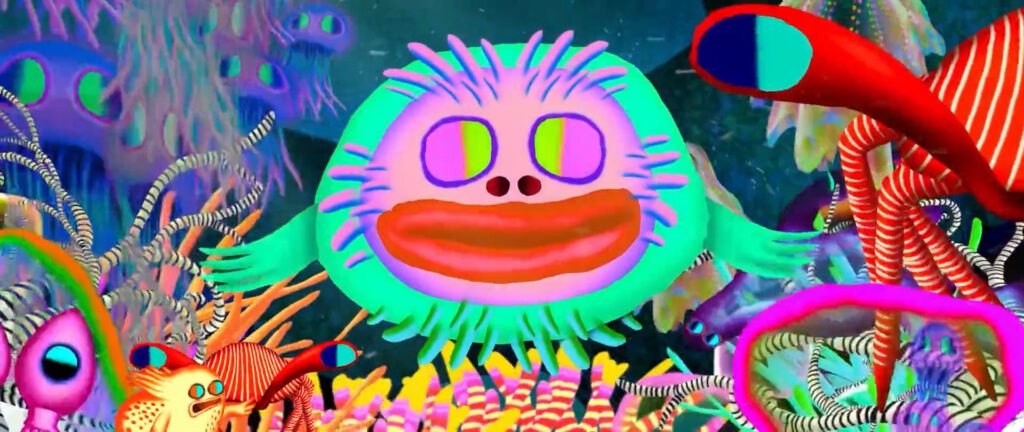
Diverting our attention briefly back to real life, Aldous shows me a video of the ocean bed somewhere in the world. There is, to be sure, a diverse range of beings dwelling there, but I notice their colour scheme is more muted. “It’s not as vibrant as the world I’ve created,” Aldous shrugs. “It’s a festival, it wants to be fun.”
Aldous Kelly is interested in social observations. Much of his art has the feel of people-watching. Sometimes it’s like a frame has been thrown lasso-style around his aloof oddballs, who don’t seem to notice that they’ve been cast in an artwork alongside strangers.
Now, his attention has turned to creatures we’ve never seen before. Gathering together, they form a charming little community. They are bizarre and monstrous, but they’re also just like us.
*
Generally speaking, the deep ocean is not an element in which we’re comfortable. Here, humanity finds that it has gone beyond its natural limits.
But, looking closer, we see a rare beauty in the critters that have evolved down there. And ocean ecosystems are more precious and fragile than we might think. Ocean environments are destabilised thanks to the activities of commercial fisheries and underwater mining and energy operations – as well as what we get up to on dry land. Even on a submarine journey to the deepest part of the ocean, we can find marine rubbish: surveyors have found beer cans and yoghurt cups in the Mariana Trench, more than 10,000 feet below the surface of the ocean.
Aldous describes his oceanic artwork for the Festival as “a celebration of this world”. In its own way, it’s a work of advocacy for the biological marvels that surround the Tasmanian archipelago. We think of them less often than we do their terrestrial counterparts, but they’re in urgent need of our protection.
These playful, whimsical specimens will make plenty of appearances throughout Ten Days on the Island. Aldous’s creatures will pop up from the programme’s pages, emerging from phone screens to populate public spaces.
Having plunged into the watery realm of fantasy, Festival attendees will have the chance to draw the oceanic organisms we’ve seen on our adventures in the deep – adding to the mysterious glistening rainbow we might (possibly) find far below the ocean surface.
This cast of characters reminds us that we are still connected to a realm that exists far beyond our ordinary comprehension. As we resurface, we find there’s more room than ever to imagine what’s out there.
